Glossary of terms

According to Carver & Scheier (1998) you can understand a lot about human behaviour if you start from a basis of goals and feedback. This allows you to see human beings and our behaviour from a systems perspective, which gives context to a lot of terminology you find in psychology and beyond. Much of the content in this post is adapted from their book "On the Self-Regulation of Behaviour"
The aim of this post is to provide you with a holistic map of human behaviour – a very high level ‘index’ of terms that may be useful to understand future content I post here. In studying the humanities, you will find a lot of content on each of the topics listed, but you hardly ever find how everything comes together into a holistic and useful model. That is what I am trying to do here.
In doing so, there may be a lot of compromises. This is not a scientific paper. The goal is this not to be 100% accurate, but rather to be as useful as possible. To this end I expect I will be updating this page quite often as my own learning progresses.
The starting point: you are not a noun, you are a verb
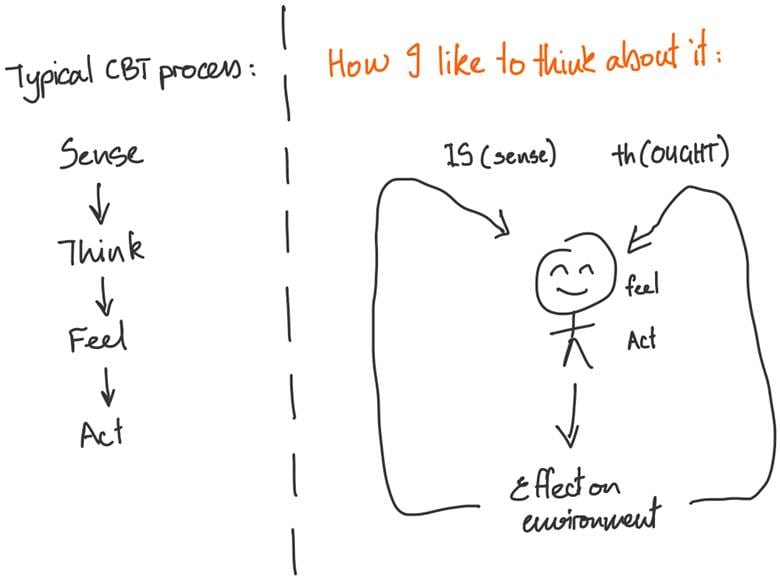
Cognitive science, and more specifically Cognitive-Behavioural Therapy (CBT) likes to portray human beings, and our behaviour into a series of steps:
- Sense
- Think
- Feel
- Act
There’s an intuitive logic to it. At the same time you will easily recognise that you are much more complex than this would imply. It is however a very useful model for understanding and making sense of our own patterns of sensing, thinking, feeling and acting, which has been proven to be effective in many psychological settings and interventions.
If you build on this, by adding in goals and feedback loops, you have an extremely useful model for understanding human behaviour on the individual and group levels.
This is you, now:

Only the now exists, and you have senses that help you figure out what’s happening in and around you. I like to call this “IS”.
You also have wants/needs/values/goals that does not exist in the now, but drives you forward to a time/place where they do exist. Cyberneticists calls this your ‘reference value’ – the thing you are comparing “IS” with. I like to call this “OUGHT”.
In your mind you continuously compare “IS” with “OUGHT”, which drives what you feel and how you act, which in turn has an effect on the environment.
Finally, this creates a feedback loop back through your senses to tell you whether you are moving toward that which you want, and away from that which you don’t want.
However, there is another feedback loop that operates on your reference value.
Consider this quote from Echart Tolle, from his book The Power of Now (1998):
"If you find your here and now intolerable and it makes you unhappy, you have three options: remove yourself from the situation, change it, or accept it totally."
The first two options are about behaviour - moving away from, and moving toward...the last option, acceptance, is the one here interested in here.
As you think about and interpret the data from your senses (IS), you can choose your actions, but you can also update your goals (I will talk about this often, because there are many implications). This feedback loop is based on your interpretations of your sense data – in other words, thinking about what the sense data means. Meaning is derived by comparing IS with OUGH, in other words it is relative to you, the perceiver, and it can change by you thinking about it. Hence why in the diagram below I label OUGHT as th(OUGHT).
We are all individuals craving autonomy, but none of us are self-sufficient
We all depend on each other for our survival, and so this model of human behaviour needs to account for this by showing how our individual reference values can be nested in larger and larger references values.
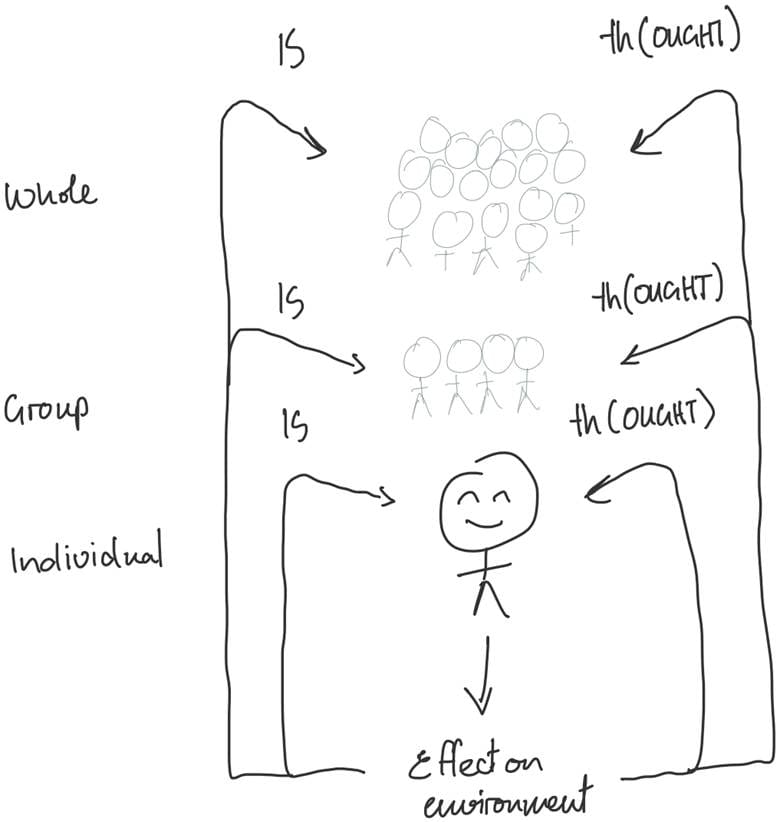
The following poem might give you a sense of what this implies:
“For the want of a nail the shoe was lost,
For the want of a shoe the horse was lost,
For the want of a horse the rider was lost,
For the want of a rider the battle was lost,
For the want of a battle the kingdom was lost,
And all for the want of a horseshoe-nail.”
― Benjamin Franklin
Lastly (at least for this post), I would like to unpack what the environment refers to in the descriptor “effect on environment”
Though I don’t know the original source, Harari (2024), proposes three levels to reality:
Objective reality encompasses the dimensions of space, and time referring to the concrete, objective things we can observe through our senses.
Subjective reality encompasses our individual subjective interpretations of what things mean (relative to our reference values).
Intersubjective reality encompasses the agreements we have between individuals of what things mean. Example: One day it was called the Gulf of Mexico, the next it was called the gulf of America. Nothing changed in objective reality, but much changed in our minds.
Th(OUGHT) - our experience and interpretations of what things mean, only exists subjectively and/or intersubjectively. Our actions/behaviour occur in the objective world, in order to move us closer to the th(OUGHT) we want. This is how we verb.
Some "definitions" as they relate to the models above
Next is a list of topics/areas of study in psychology and the humanities, with a short description of how they relate to the models above. Again the idea here is simply to be useful – to illustrate how a cybernetic model of human behaviour can serve as a holistic model that might aid in self and other development.
Attention: What you focus on/are aware of, which determines what information you notice and respond to. Very limited - a constraint in your process.
Memory: Your stored experiences that help you make sense of what’s happening now and what to do next. Forms part of your th(OUGHT). Allows you to get a sense of 'past' and 'future', beyond just the IS that is NOW.
Autonomy: Your ability to choose and update your own goals/th(OUGHT), as well as HOW you will attain it, instead of just reacting to outside pressure.
Locus of control: The degree to which you are confident in your ability to achieve the outcomes/th(OUGHT) you're aiming for.
Values/Needs/Outcomes: The things that matter to you and define what th(OUGHT) looks like.
Feedback: Information about whether your actions are moving you closer to or further from what you want, or away from what you don't want.
IS: Data from your senses, telling you what is happening right now, as you experience it.
Th(OUGHT): What you believe should be happening, based on your goals, values, and interpretations.
Decisions: Choices you make about how to act in order to move from IS toward th(OUGHT).
Actions: What you actually do in the real world to change your situation.
Feelings: Immediate signals (feedback) that tell you how things are going for you in the moment relating to the most salient IS->th(OUGHT). Also provides energy for action.
Emotions: Stronger, more stable and organised feeling states that prepare you to respond to important situations.
Emotional intelligence: Traits that help you manage yourself and others. Can indicate the 'quality' of how you verb.
Personality: Describes how and why individuals differ in terms of the reference values/th(OUGHTS) they choose, and how they close the gaps between IS and th(OUGHT). Your typical way of thinking, feeling, and acting across situations.
Identity: The story you hold about who you are, which shapes the goals you set, the feedback you notice, and how you act. Be wary of thinking about yourself as a noun.
Reputation: The shared story others hold about you, formed from the visible effects of your actions over time.
Engagement: How much energy and attention you put into what you’re doing.
Responsibility: Taking ownership of doing your part to influence what happens.
Accountability: Being answerable for outcomes, based on shared expectations.
Leadership: Helping people align around what matters and move toward it together.
Strategy: A guiding plan for how to act over time to get where you want to go.
Conclusion
As I said at the start, this post is not scientific. It is a work in process aimed at self and other development. Some might have a heart attack at my oversimplifications. The goal is to build a useful and holistic foundation for understanding human and organizational behaviour to help people better understand and manage themselves, and others.
References
Carver, C., & Scheier, M. (1998). On the self-regulation of behavior. Cambridge University Press.
Harari, Y. N. (2024). Nexus, A brief history of information networks from the Stone Age to AI. Penguin Random House UK.
Hui, Y. (2024). Cybernetics for the 21st century: Vol. 1 Epistemological reconstruction. Hanart Press.